
Last updated on September 17th, 2026 at 08:46 am
I’ve been doing forensic SEO work for a criminal defense firm lately, going through the website URL by URL and trying to determine what actually deserves to remain.
Not what a crawler says is good. Not what a score in an SEO tool says is good. But what is genuinely useful, unique, accurate, and worthy of showing up in search engines.
It is slow work, but I love it. I have spreadsheets open everywhere!
I am comparing pages, checking search data, looking for overlap, reviewing old redirects, and deciding whether each URL should be improved, consolidated, redirected, or removed.
Somewhere in the middle of all that, I started thinking about Alan Bleiweiss.
Alan was someone I looked up to long before I had the chance to meet him online. He was known for incredibly detailed, surgical SEO audits. He did not just run a website through a tool and hand over a list of errors… he dug into the evidence, understood how the pieces connected, and worked to find the real cause of a problem.
And he was able to explain it plainly too.
I was lucky enough to meet him and eventually work alongside him. During one project, we spent time discussing schema implementation and how to build something we could fully control instead of becoming dependent on another platform. That kind of thinking was very Alan. Understand the system, question the easy answer, and build what is right for the site.
Alan passed away last year while we were still working on the same project. I miss the guy.
What brought him back to mind was not a particular SEO tactic. It was the process below.
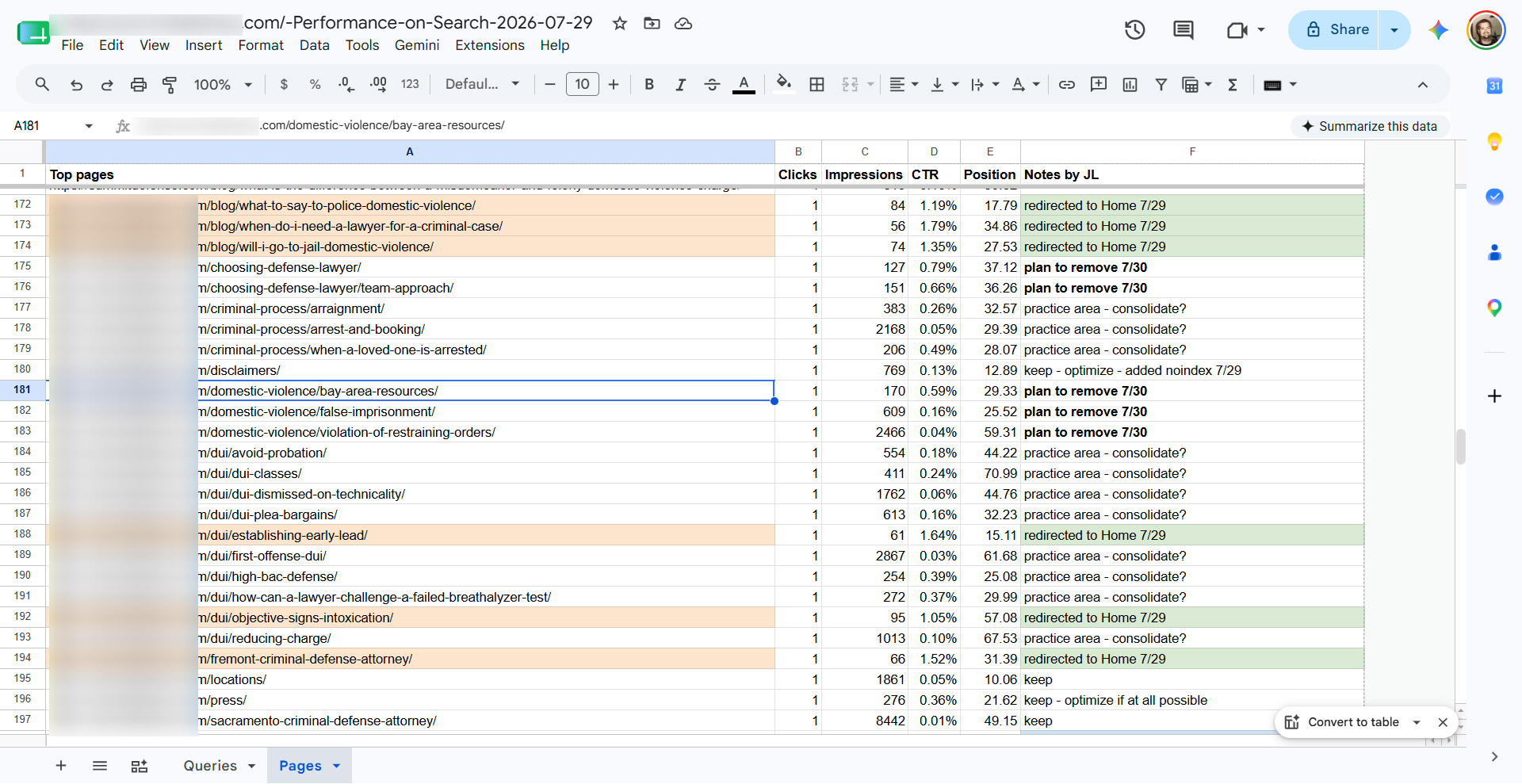
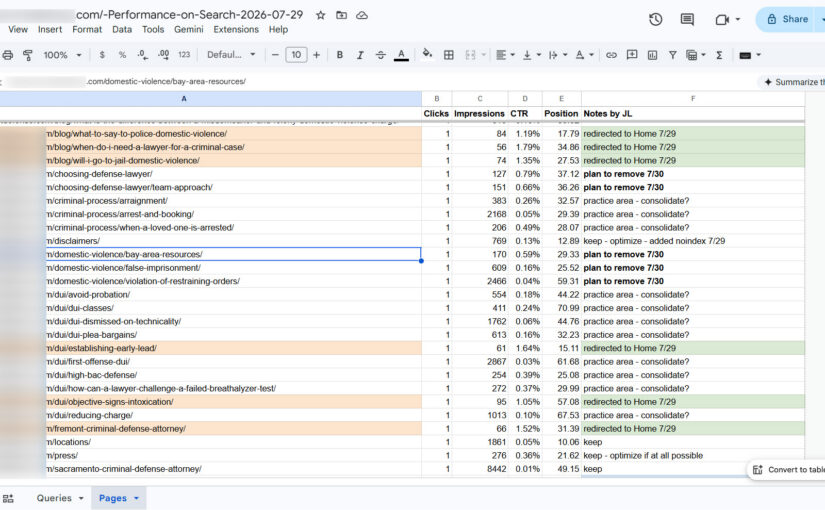
There’s 100s of URLs on this website, and it would be easy to make broad decisions based on word count, traffic, or a crawl report. But none of those numbers tells the whole story. A page with little traffic may still serve an important purpose. A page with traffic may be outdated, duplicated, or attracting the wrong audience. A technically healthy page may still have no real reason to exist.
That is why I am reviewing them individually.
For each URL, I am asking:
- does this page provide something useful and distinct?
- does it match what someone is actually searching for?
- is it competing with another page on the same website?
- does it support the firm’s practice areas and locations?
- should it stay, improve, merge with something stronger, or disappear?
This is the kind of SEO work I enjoy most. It is part investigation, part cleanup, and part rebuilding. The spreadsheet is not the strategy but a simple and colorful space where I organize the evidence so I can make better decisions.
Alan understood that good technical SEO requires judgment. Tools can find clues, but they cannot fully understand a website, a business, or the people searching for help.
Going through this site so carefully has reminded me how much his approach influenced mine. Be thorough. Follow the evidence. Do not assume the obvious answer is the correct one. Most importantly, care enough to look deeper.
I wish I could show him the spreadsheet.
I think he would understand exactly why I built it.
